
AI in Orthopaedics:
Current Uses and Future Developments
Orthopaedic Opinions Blog
By Mr Vipin Asopa, Consultant Hip & Knee Surgeon
December 2025
Artificial Intelligence (AI) is being used in a variety of ways across many industries including retail and eCommerce, finance, manufacturing, and notably, medicine and healthcare.
As an orthopaedic surgeon, I am excited by the new and innovative ways we are able to use artificial intelligence in the field of orthopaedics, to the benefit of our patients. With the addition of AI, it is possible to increase precision during operations with AI-based navigation systems for a surgeon’s instruments.
This enhanced accuracy has many benefits for patients as it can lead to improved surgical outcomes, and it enables surgeons to perform procedures using smaller incisions. As a result, patients experience reduced scarring and benefit from a smoother recovery process.
USING AI TO AID HIP REPLACEMENT SURGERY
AI is proving to be beneficial throughout the entire process of hip replacement surgery, from the initial planning stages to post-operative rehabilitation, as outlined below:
Operative procedure scheduling
The scheduling of theatre operation cases can be more efficient through the use of artificial intelligence. This could help improve operating theatre utilisation.
Preoperative Planning
AI can be used to generate a 3D model of a patient’s hip joint based on medical imaging data, which can help surgeons plan and prepare for the surgery. This can include optimising implant placement and sizing, as well as anticipating potential complications.
Surgical Navigation
During surgery, AI-based navigation systems can help guide the surgeon’s instruments and provide real-time feedback on the positioning and alignment of the implant.
Patient-Specific Implant Design
AI can be used to design patient-specific implants based on a patient’s unique anatomy, which can lead to better fit and function of the implant.
Postoperative Rehabilitation
AI-based systems can help monitor a patient’s recovery progress and provide personalised rehabilitation plans based on individual needs and progress.
AI IN ORTHOPAEDICS 2024 EVENT
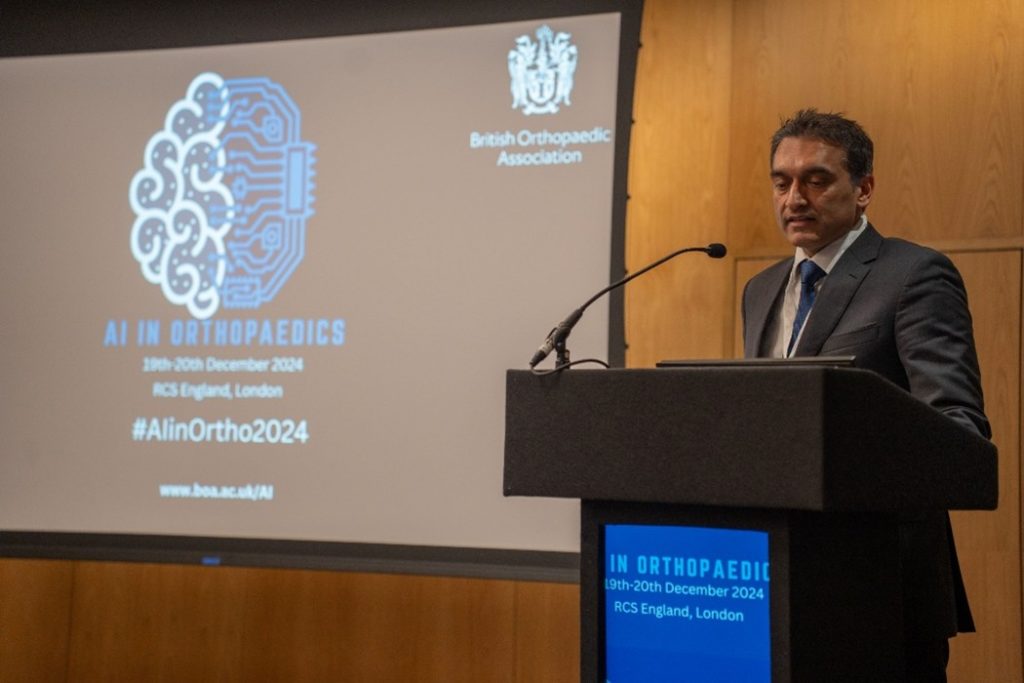
In December 2024 I co-organised a national AI meeting – AI in Orthopaedics and MSK 2024 – an event which saw stakeholders discussing the advances in medical AI. From the fundamental principles of AI, uses, limitations, and further considerations, this event explored many aspects of artificial intelligence in orthopaedics.
Photo credit: British Orthopaedic Association
AI HACKATHON COMPETITION 2024
Amongst discussions of AI in orthopaedics, we held the ‘AI Hackathon in Orthopaedics’ competition. This involved the use of coding in “creating a predictive model based on tabulated data, similar to the approach by Motesharei et al. (Predicting robotic-assisted total knee arthroplasty operating time: benefits of machine-learning and 3D patient-specific data.)”
https://www.boa.ac.uk/learning-and-events/ai-in-orthopaedics-and-msk-2024/hackathon-boa-ai-in-orthopaedics-and-msk-2024.html
AI IN ORTHOPAEDICS 2025 EVENT
With collaboration amongst healthcare professionals and computer scientists key to the development of AI, the event returned for ‘AI in Orthopaedics: Shaping the Future of Musculoskeletal Medicine’, in December 2025.
FUTURE DEVELOPMENTS IN ORTHOPAEDICS
Overall, artificial intelligence can help improve the accuracy and precision of hip and knee replacement surgical procedures, reduce the risk of complications, and enhance patient outcomes through a number of different means. This will likely continue to develop and evolve as we learn more and AI adapts further in it’s abilities to learn in close to real time.
The field of AI in orthopaedics is advancing, but ongoing development and continuous learning will be essential.
When exploring the future of AI in orthopaedics for The British Orthopaedic Association (BOA) last year, we noted that, “as we look to the future, interdisciplinary collaboration among computer scientists, data analysts, orthopaedic surgeons, and other healthcare professionals will be vital for advancing AI technologies within clinical settings.”
“The concept of ‘data half-life’ — the period after which data may become less relevant — underscores the need for AI models that can update their knowledge base in real-time to reflect the latest medical insights.”
[Reference: Chen JH, Alagappan M, Goldstein MK, et al. (Int J Med Inform 2017;102:71-9), https://www.boa.ac.uk/resource/integrating-artificial-intelligence-into-trauma-and-orthopaedics.html]
FURTHER INFORMATION
https://www.boa.ac.uk/resource/integrating-artificial-intelligence-into-trauma-and-orthopaedics.html
https://www.boa.ac.uk/learning-and-events/ai-in-orthopaedics-and-msk-2024.html
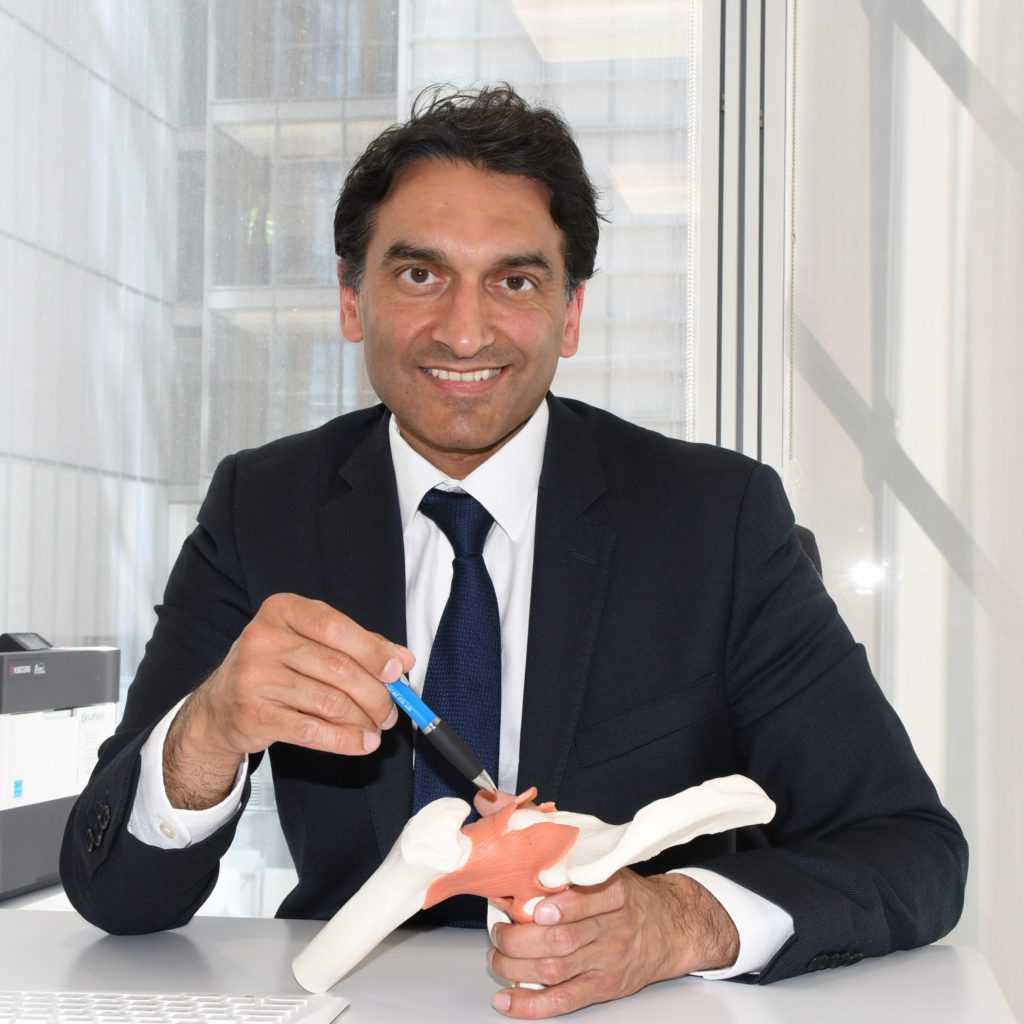
Mr Vipin Asopa, PhD, FRCS (Tr & Orth), MBChB, BSc (hons)
Specialist Consultant Hip and Knee Surgeon in London, with a particular focus on hip pain, knee pain and sports injuries.
Mr Asopa performs numerous surgical procedures including hip and knee joint replacements, arthroscopy, ACL surgery, as well as treating arthritis, ligament injuries, trochanteric pain and more.
To book an appointment with Mr Asopa:
Call: +44 (0) 794 319 1592 | Email: admin@ortho-surgery.uk